
Best towing software in 2026: a straight-talking buyer guide
An independent Canadian buyer guide to towing software. Compare the real dispatch, impound and billing tools in one table, see what each tier costs in Canadian dollars, and find the one layer of the stack every vendor skips: how the phone gets answered.

Which towing software is best depends entirely on the job you need done. Towbook leads on dispatch, Omadi and Tracker on full fleet management, Ranger SST and Beacon on impound and storage. Most run from free up to around 525 dollars a month. None of them answers your phone, and that is the gap we get to further down.
Towing software is the system that runs a towing and roadside business off the truck: it logs the call, dispatches the nearest driver, tracks the job by GPS, manages your impound and storage lot, and raises the invoice, whether it is a motor-club rate or cash. Most "best software" pages out there are vendor product pages dressed up as buyer guides, or a directory that hides the pricing. This one is organized by the job to be done, names real tools fairly, and shows what they cost in Canadian dollars.
The main options at a glance
| Software | Best for | Pricing |
|---|---|---|
| Towbook | Cloud dispatch, the popular all-rounder | From around 65 dollars per month |
| Omadi | Full fleet management, larger operators | Quote-based |
| Tracker Management | Established all-in-one, impound lots | Quote-based |
| Beacon (Dispatch Anywhere) | Dispatch and storage, mid to large | From around 135 dollars per month |
| Ranger SST | Impound and lot management | Quote-based |
| VTS Fleet | GPS and fleet tracking | Quote-based |
| TOPS | Value all-in-one, smaller fleets | From around 85 dollars per month |
| Octopuspro | Budget field-service, solo operators | From around 13 dollars per user per month |
| Jodie | The front desk: answering the phone | Flat monthly fee |
Prices move and most of the bigger platforms quote per fleet, so always confirm current tiers with the vendor. The pattern that matters holds steady: the dispatch tools run from free or a low monthly floor up to a few hundred dollars a month, and not one of them answers your phone.
Choosing by job, not by brand
Towing software gets a lot easier to pick once you stop comparing brands and start comparing the jobs each one actually does. Most operators need four things, and the leaders are different in each.
- Dispatch. Logging the call, assigning the nearest truck, and tracking it by GPS to the breakdown. This is the core of the job. Towbook is the popular all-rounder; Omadi and Beacon scale to bigger fleets with more drivers to juggle.
- Impound and storage. Lot management, daily storage charges, release paperwork and police or provincial registry notifications. If recovery and storage are a real part of your income, this matters as much as dispatch. Tracker Management and Ranger SST are strong here; Towbook covers it lighter.
- Billing and invoicing. Turning a tow into a paid invoice, whether it is cash at the roadside, a motor-club rate or a fleet account. Judge it on speed and on whether it pushes to your accounting software rather than making you rekey.
- Motor-club integration. Digital dispatch from CAA, Agero and the roadside networks, with jobs landing straight in your queue instead of arriving by phone. Towbook, Omadi and Beacon all connect to the major digital-dispatch networks; this is the feature that saves the most time once you are on a panel.
For most operators the honest answer is a single platform that does all four competently, rather than four best-of-breed tools you have to stitch together. A one-truck operator and an eight-truck firm with two impound yards are buying very different things.
The free and freemium options
"Free towing software" is a real search for a reason: every new operator wants to start cheap. The honest take is that free gets you going but rarely gets you far.
A handful of tools offer a free tier or a trial, and general field-service apps like Octopuspro start cheap enough to feel free. What they tend to lack is the towing-specific plumbing: digital dispatch from the motor clubs, real impound and storage lot management, and clean motor-club invoicing. That is fine for proving the model with one truck and a notebook. Once you are on a motor-club panel and turning real volume, you hit the cap, and the paid tier you were always going to need shows up. Budget for it from the start so it is not a surprise.
The layer every vendor leaves out: the front desk
Here is the gap no towing software vendor will mention. Every tool above starts working the moment a job exists in the system. But a job only exists once someone has answered the phone, taken the location and the vehicle, and put it on the board.
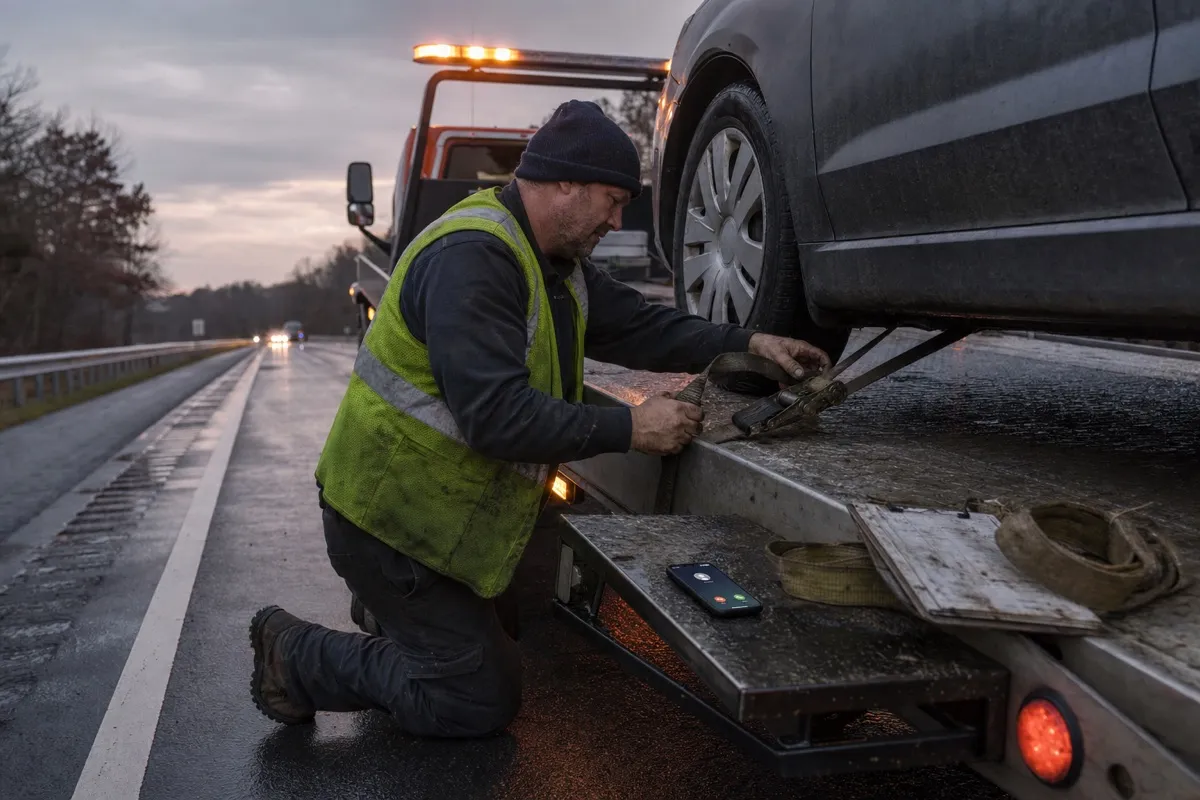
Your dispatch software does not answer the phone. In towing the phone rings at the worst possible moment, when your driver is winching a car onto the flatbed, strapping it down on the shoulder, or asleep at 3am. The stranded caller will not leave a voicemail; they call the next tow company on the list. That call is invisible to your software, and so is the job and the storage income attached to it. As we cover in the guide on how a towing business actually makes its money, an unanswered roadside call is simply an unbilled job.
An AI answering service is the modern version of the front desk. It answers every inbound call instantly, day or night, holds a real conversation, captures the location, the vehicle and the problem, and texts the details straight to you, so the call turns into a job your dispatch software can then run. It does not replace Towbook or Omadi; it feeds them the tows that would otherwise ring out while your driver has both hands on a strap.
How to pick the right stack for your company size
Work through it in this order rather than starting from a brand name:
- Size first. One or two trucks: Towbook, TOPS or a value field-service app to start. Three or more trucks, multiple drivers or an impound yard: a full platform like Omadi, Beacon or Tracker Management that handles fleet and storage properly.
- Pick your one non-negotiable. Heavy on motor-club work, prioritize the digital-dispatch integrations. Heavy on impound and storage, lean Tracker or Ranger SST. Heavy on a big driver roster, look at Omadi or Beacon.
- Check the integrations. It should push to your accounting software and connect to the motor-club networks you run, so you are not rekeying jobs or invoices.
- Then fix the front desk. Whichever platform you choose runs the jobs you capture. Make sure something is actually capturing them by answering the phone, around the clock, while your drivers are out on the road.
The right stack is the one that fits your fleet size and the mix of roadside, tow and storage work you do, with a front-desk layer in front of it so the calls you paid to attract actually become jobs. For the bigger picture on running the phones, see how Jodie works for towing and roadside firms, and for filling the order book in the first place, our guide on winning towing contracts.
Frequently asked questions
- What is the best towing software for a small towing company?
- For a one or two-truck operator, the common pick is Towbook: cloud-based dispatch with motor-club digital dispatch built in and a low entry price. Smaller shops also run TOPS or Octopuspro for value. Match the tool to your truck count and how much impound and storage work you do, not to whoever ranks first.
- Is there free towing software?
- Sort of, but with limits. A few tools advertise a free tier or trial, and general field-service apps can be bent to fit, but a true "free towing software" rarely covers real digital dispatch from CAA and the motor-club networks, impound lot management, or invoicing. Free works to prove the model; once you run real volume you usually outgrow the cap and pay anyway.
- What software do tow companies use to dispatch?
- The category leaders are Towbook, Omadi, Tracker Management Systems and Beacon. Each handles call logging, job assignment, driver mobile apps and GPS, and connects to motor-club digital dispatch so jobs from CAA, Agero and the roadside networks drop straight into the queue. Larger fleets lean to Omadi or Beacon; smaller ones to Towbook.
- Does towing software answer the phone or handle after-hours calls?
- No. Every platform here only starts working after a call has been answered and a job created. None of them picks up an inbound roadside call, so when your driver is on the flatbed at 2am, the ringing phone is invisible to your software. That front-desk layer is the gap an AI answering service fills.
More towing services guides
How to get towing contracts in Canada: motor clubs, police rotation and private accounts
A practical playbook for landing towing contracts in Canada: the four account types, who to approach for each, what they require, and the 24/7 answer rate and arrival time that win the work and hold it.
How profitable is a towing business in Canada?
What does a Canadian towing business actually clear? A look at revenue per truck and per job, the costs that quietly thin the margin, and why every call you miss is a tow that bills nothing.