
What a vet front desk really costs: software, staff and missed calls
The honest operator view of what a veterinary front desk costs a practice owner in Australia: practice management software pricing, the real cost of a receptionist seat the software cannot replace, and the lost-appointment maths on calls that go unanswered.

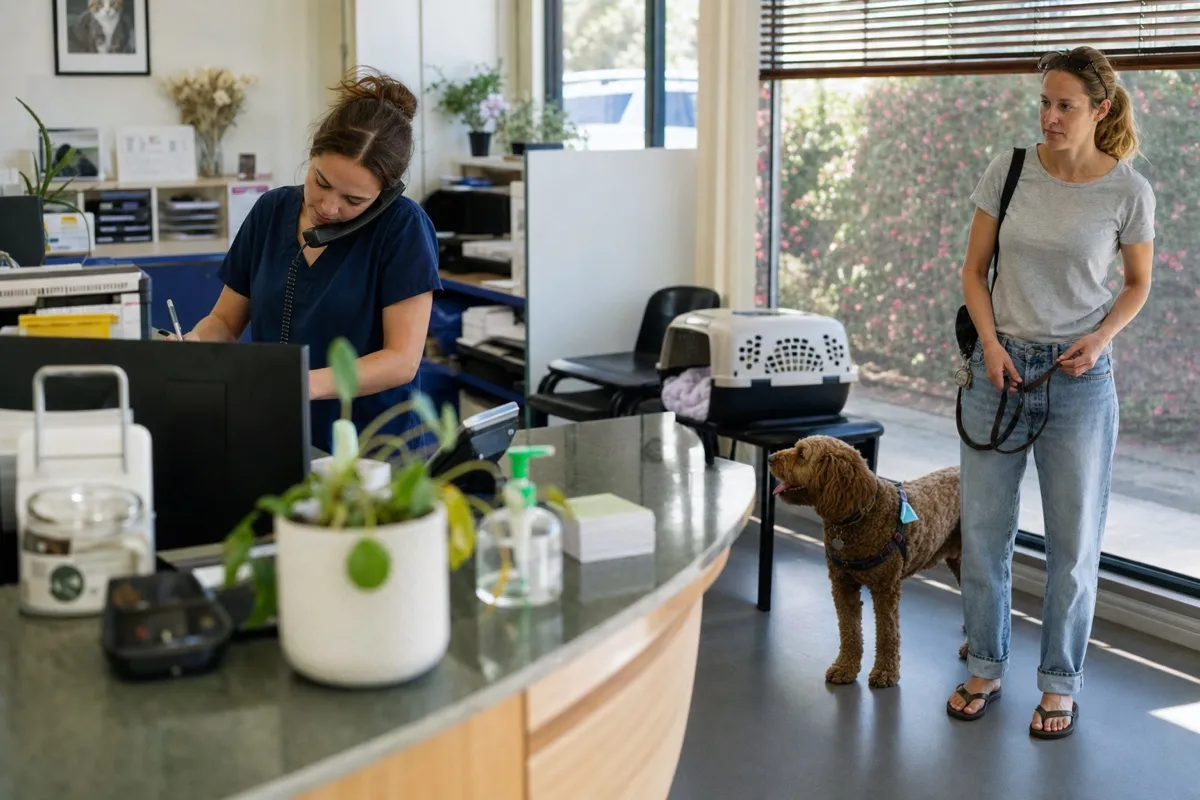
A vet front desk has three real costs: the practice management software, the receptionist seat that software never replaces, and the appointments you lose when nobody answers the phone. For a typical single-site practice that adds up to a few hundred dollars a month in software, a full receptionist seat costing well above the advertised wage, and a missed-call leak that quietly runs into thousands a year.
Most owners can quote the software price to the cent and have never costed the other two. Those are the expensive ones.
| Front-desk line item | Typical cost | What people forget |
|---|---|---|
| Practice management software | A few hundred dollars a month, or a larger upfront licence | Setup, data migration and training on top |
| Receptionist seat | A full salary plus on-costs and cover | The desk is empty at lunch, evenings and weekends |
| Missed and after-hours calls | Thousands a year in lost appointments | It never shows up on any invoice |
What practice management software costs
Practice management software, the PIMS, is the line everyone benchmarks first because it is the easiest to price. Broadly there are two models, and they cost very differently over time.
Cloud systems are billed per vet or per user, per month. For a small to mid-size practice that usually lands somewhere around 150 to 450 dollars a month, scaling with how many seats and modules you switch on. On-premise systems flip that: a larger upfront licence, often several thousand dollars, plus a server, ongoing support and backups.
| Cost line | Cloud (per month) | On-premise (upfront + ongoing) |
|---|---|---|
| Software licence | Per vet or per user fee | Larger one-off licence |
| Server / hardware | Included | Several thousand dollars, replaced every 3 to 5 years |
| Support | Usually bundled | A monthly support contract |
| Backups | Included | A separate monthly cost |
| Setup and migration | Setup and training fee | Setup and training fee |
The two numbers people miss are setup and data migration. Moving years of patient records off an old system is rarely free, and the training time while your team gets up to speed is a real cost even when the vendor does not bill for it. "Free" tiers exist, but they cap seats, patients or features fast, and they do nothing about the cost lines below. If you are still choosing a system, we walk through the main options in our guide to the best veterinary practice management software.
What a receptionist seat really costs
Here is where the real money is, and where the advertised wage badly understates the bill. The headline salary is only the start of what a receptionist seat costs you.
- Superannuation, and payroll tax where your wages bill triggers it, on top of the wage.
- Annual leave cover, and sick leave cover, so the desk is never unstaffed.
- Recruitment and training every time someone leaves, which in a front-desk role is often.
- The management time spent rostering, supervising and covering the desk yourself when you are short.
Add those up and a single full-time reception seat costs a practice well above the base salary, every year. And no practice management software replaces it. The PIMS holds the records and the diary; it does not greet a client, calm a worried owner, or pick up the phone. That is a person.
The catch is that even a fully staffed desk is not a desk that is always answering. It is empty at lunch, after the practice closes, on weekends, and whenever both lines ring at once and someone is already on the phone. Those are exactly the moments a new-client call comes in.
The cost you never see: missed and after-hours calls
This is the line item with no invoice, which is precisely why it is the one owners under-cost. Every front desk has a ceiling on how many calls it can answer, and the calls that hit a busy line or a closed practice do not wait. A worried owner with a sick pet rings the next practice on the list.
So do the maths nobody does. Say a new client and their pet is worth a first appointment plus the lifetime of repeat visits, vaccinations and the odd procedure. Now say only a handful of genuine new-client calls a week go unanswered, busy line, lunch, or after hours.
- A few missed new-client calls a week
- Even if only some of them would have booked
- At the value of a first appointment, plus the lifetime value of a registered client
- That is thousands of dollars a year walking to the practice down the road
You already paid to make that phone ring. Your marketing, your reviews, your Google listing all exist to generate that call. We cover the demand side in our guide to getting more clients for a veterinary practice, but the cheapest growth of all is simply not losing the calls you already paid to create.
Where automation pays back
Once you have the three costs on one page, the question changes. It stops being "software or staff" and becomes "where does each dollar of front-desk budget actually pay back".
A second receptionist seat buys you more answered calls during opening hours, at the cost of another full salary plus all the on-costs above, and it still clocks off in the evening. An answering and booking layer sits across the gap the desk cannot cover, the busy moments, the lunch break, the nights and weekends, for a fraction of a second wage. It is not a replacement for a good front-of-house team. It is cover for the hours that team cannot physically be on the phone.
That is the honest place an AI answering service like Jodie fits: catching the calls a busy or closed desk would otherwise drop, booking the appointment, and passing the details straight to your team. To see how that works for a practice, start with our overview of answering for veterinary practices.
Putting it together: the front-desk budget
For a typical single-site practice, the front-desk budget is software in the low hundreds of dollars a month, at least one reception seat costing well above its advertised wage once super, leave and cover are included, and a missed-call leak that, left alone, is usually the biggest of the three.
The point is not the exact figures, which will move with your practice size, your software and your local wages. The point is to put all three lines on the same page, because owners reliably price the first, under-price the second, and forget the third entirely. Run your own version this week: your real software cost, your true cost-per-seat, and your honest guess at missed new-client calls. Then decide where the next dollar of front-desk spend pays back hardest. When you are ready to choose the system that anchors it all, our guide to the best veterinary practice management software is the place to start.
Frequently asked questions
- How much does veterinary practice management software cost?
- Cloud practice management software is usually priced per vet or per user, per month, typically somewhere around 150 to 450 dollars a month for a small to mid-size practice. On-premise systems trade that monthly fee for a larger upfront licence (often several thousand dollars) plus a server, support and backups. The headline price is rarely the whole bill once you add setup, data migration and training.
- What does a veterinary receptionist cost a practice?
- More than the wage on the job ad. Once you add superannuation, payroll tax where it applies, annual and sick leave cover, training, and the cost of replacing someone who leaves, a single full-time receptionist seat usually costs a practice well above the base wage. And that seat is still empty at lunch, in the evenings and on weekends, which is exactly when a lot of new-client calls come in.
- How much do missed calls cost a veterinary practice?
- Do the maths: calls you miss per day, times your answer-to-booking rate, times the value of a first appointment and the lifetime value of that client. A handful of missed new-client calls a week, at the value of a new patient over its lifetime, runs into thousands of dollars a year. It is the biggest front-desk cost most owners never put on the books.
- How much does it cost to set up a veterinary practice?
- Fit-out, equipment and stock dominate the start-up budget, but the cost owners most often underestimate is the recurring front-of-house one: software, the reception seat, and a way to answer the phone when the desk is busy or closed. Those are the lines that keep costing you every month after the doors open, so budget them properly from day one.
More vet clinics guides

Best veterinary practice management software in 2026: an Australian buyer's guide
A vendor-neutral guide to veterinary practice management software for Australian clinics: a real comparison table of the main PIMS by practice size, cloud vs on-premise, how the pricing works, and the one job every system leaves to your front desk - answering the phone.

How to get more clients for your veterinary practice
A straight-talking growth playbook for independent Australian vet practice owners: which marketing channels are worth the spend, how to win on reviews and word of mouth, and why the demand you already pay to create is wasted if nobody answers the phone.
What a dental front desk really costs (and the price of every missed call)
The wage on the job ad is the small number. Here is the true cost of a dental front desk - salary, superannuation, payroll tax, leave and absence cover - set against the new-patient calls that drop to voicemail.