
The real cost of missed calls for a Canadian plumbing business
Few plumbers ever tally up what slips away each time the phone rings and goes unanswered. Here is the plain math, and the cheapest ways to plug the leak.

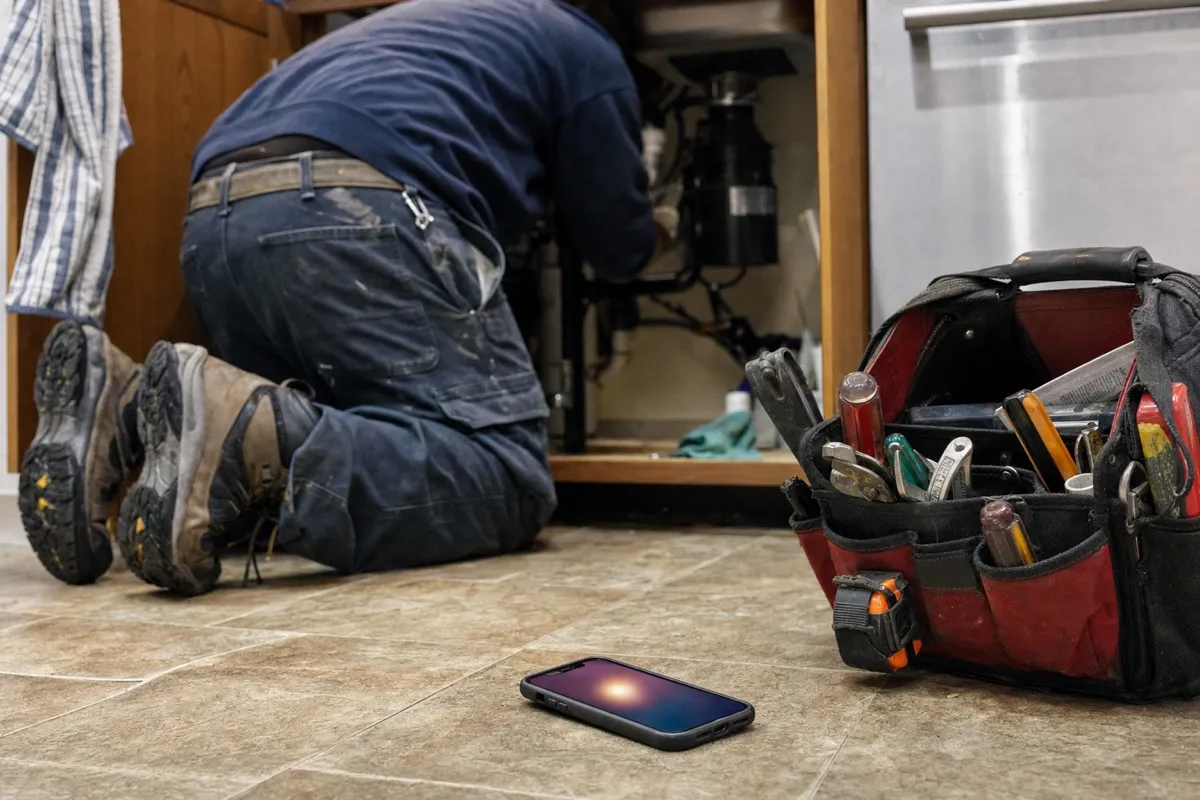
Ask a plumber how the trade is treating them and you will hear all about the jobs they finished this week. What you almost never hear about are the jobs they never knew existed: the calls that landed while they were under a sink, up a ladder, or dead asleep at 2am with the ringer off.
Those calls leave no trace. There is no missed-job report waiting in the inbox. So most plumbers quietly figure the cost is small. It is not.
The math nobody runs
Let's run the number that never gets run. Say a typical job for your business, a service call plus a repair, comes to around 290 dollars. Nothing exotic, just an average across emergencies, small fixes, and the occasional bigger piece of work.
Now say five genuine new-customer calls a week go unanswered. Not wrong numbers, not suppliers, not the same person calling back twice. Five real people with a problem and a wallet.
- 5 missed calls a week
- Even if only half of them would have booked, that is roughly 2 to 3 jobs
- At 290 dollars a job, that is around 725 dollars a week
- Over a year, that is more than 37,000 dollars
That is not a rounding error. For plenty of one-truck plumbing outfits, it is the gap between a strong year and a flat one, and it is money you already spent to earn. You paid for the Google listing, the truck lettering, and the website that made the phone ring. The call is the cheap part to lose and the expensive part to lose.
Why plumbers miss calls (it is not laziness)
The reason plumbers miss calls is the same reason they are worth hiring: they are flat out doing the actual work.
- You cannot pick up with your hands inside a water heater.
- You cannot take down details while you are driving between jobs.
- You are not going to wake up at 2am for a blocked number, and you should not have to.
- When two calls come in at once, one of them loses.
None of that is a personal failing. It is simply what one phone and one person can physically manage. The trouble is that the caller does not know or care why you missed it. They just move on.
What the caller does next
This is the part that makes missed calls so expensive. A plumbing emergency is one of the most urgent purchases a person ever makes. They are not browsing. Their deadline is measured in minutes.
So when you do not answer, they do not hang around. They tap the next result on Google. By the time you surface and notice the missed call, the job is already booked with someone else, and that customer is now their customer, not yours, for every future job too.

Your options, honestly compared
There are really only a handful of ways to stop missing calls. Here is how they stack up for a working plumber.
| Voicemail | Call back later | Hire a receptionist | Jodie | |
|---|---|---|---|---|
| Answers every call | Sort of | No | Office hours only | Yes, 24/7 |
| Captures job details | Rarely | If they answer | Yes | Yes |
| Works nights and weekends | Yes | No | No | Yes |
| Monthly cost | Free | Free | High | Low |
| Caller reaches a real conversation | No | No | Yes | Yes |
Voicemail feels like a safety net, but most callers never leave a message. "I'll call them back" only works if the customer has not already booked someone else, which for emergencies they usually have. A receptionist solves the problem beautifully but costs a full salary and still clocks off at five. We break each option down properly in our guide to answering services versus voicemail versus a receptionist.
That gap, every call answered without a full-time wage, is exactly the gap an AI receptionist fills.
The point is not the exact number
Your real figure might be higher or lower than the example above. Maybe your average job is worth more. Maybe you miss three calls a week, or fifteen. The exact number matters less than the habit of running the math at all.
Take ten minutes this week to work out your own version: your average job value, multiplied by a realistic guess at missed new-customer calls. Whatever number falls out the bottom, that is roughly what answering every call is worth to you. For most plumbers, it is the single cheapest way to grow without spending another dime on marketing, and if you are still finding your feet, it is one of the first habits to build when you learn how to start a plumbing business.
You have already paid to make the phone ring. The only thing left is to make sure someone, or something, always picks it up. If you want to see how that works for a plumbing business, start with our overview of call answering for plumbers.
Related Jodie features
Frequently asked questions
- How many calls does the average plumber actually miss?
- It varies, but most independent plumbers miss a fair chunk of their calls simply because they are under a sink, behind the wheel, or asleep when the phone goes. The exact percentage is not the point. The point is that every missed call is a customer who will dial the next plumber on the list within a couple of minutes.
- Do people really not leave a voicemail?
- Most do not. When someone has water coming through the ceiling they want a live person, right now. If they hit voicemail they hang up and call the next number on Google. Voicemail recovers only a small slice of the people who would have booked.
- Is a missed call worse than a bad review?
- In straight dollar terms, often yes. A bad review trims some future inquiries. A missed call loses a job that was ready to book today, and that same caller might have turned into a repeat customer worth far more over the years.
More plumbers guides
Answering service vs voicemail vs hiring a receptionist for plumbers
Voicemail, calling back later, a hired receptionist, or an AI answering service. A straight look at what each one costs a plumbing business in Canada and which one wins for most.
How plumbers can handle after-hours and emergency calls without burning out
A frozen pipe at midnight will not wait for business hours. Here is a practical way to cover nights and weekends, triage true emergencies, and stop good jobs from slipping away after dark.
Plumbing invoicing and job-management software that actually gets you paid
A vendor-neutral buyer guide to plumbing invoicing and job-management software for Canadian trades: what each tool is best for, how per-seat pricing works, and the call-handling layer the vendors all skip.