
The real cost of a heat pump and air conditioning answering service
Providers bury the price behind a "get a quote" button. Here is the honest cost model in dollars, a realistic monthly range, and what missing one after-hours call actually costs your business.


A heat pump and air conditioning answering service usually costs between $200 and $600 a month, and the price turns entirely on the model. Per-minute services bill for every second a caller is on the line, per-call services charge a flat fee per conversation, and flat-rate AI services charge one predictable monthly price for unlimited calls. The cheapest option on paper is rarely the cheapest in practice, because the real cost is the job you miss when nobody picks up.
That last part is what the provider sales pages never tell you. They will happily explain that they answer 24/7. None of them will state a number, and none of them will do the sum that actually decides whether coverage is worth it for you.
The three pricing models, compared
Almost every answering service runs on one of three models. Knowing which one you are being quoted matters more than the rate itself.
- Per-minute. You pay for talk time, often with a monthly bundle of minutes and an overage rate once you go past it. Cheap if your calls are short and rare, brutal if a chatty caller or a busy week blows the bundle.
- Per-call. A flat fee for each answered conversation, regardless of length. Easier to predict than per-minute, but a month with a lot of after-hours emergencies still runs the meter up.
- Flat-rate AI. One monthly price, unlimited calls. No bundle to blow, no overage, no surprise on the invoice when you have a busy fortnight.
| Per-minute | Per-call | Flat-rate AI | |
|---|---|---|---|
| You pay for | Talk time | Each conversation | One flat monthly fee |
| Predictable bill | No | Sort of | Yes |
| Cost in a busy month | High | High | Same as a quiet month |
| Answers 24/7 | Often extra | Often extra | Yes |
| Best for | Very low volume | Steady volume | Anyone who hates surprises |
The trap with per-minute and per-call is that they punish you for being busy. The months you most need coverage - the first cold southerly of winter, a damp July, the rush before summer - are exactly the months the bill spikes. Flat-rate AI charges the same whether you take ten calls or a thousand.
Why heat pump firms miss the calls that matter most
The reason you miss calls is the same reason customers want to hire you: you are doing the actual work.
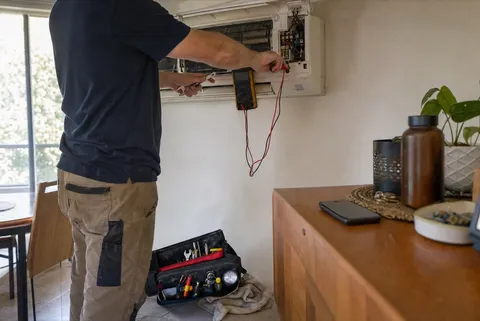
You cannot answer with your arm inside a condenser. You cannot take a caller's details while you are wiring a controller or up in a ceiling space running ducted pipework. When you are on a ladder or driving between jobs, the phone rings out. And the worst calls, the no-heat and no-cool emergencies, almost always land outside normal hours, when you are home and off the clock.
None of that is a failing. It is just what one person with one phone can physically do. The problem is the caller does not know or care why you did not pick up. They move on.
The maths: what one missed call costs
Here is the sum the provider pages never do. Say a typical heat pump job for your firm - a repair, a service, or a share of the bigger install work - averages around $520.
- Say three genuine new-customer calls a month go unanswered after hours. Not suppliers, not wrong numbers, just real people with a dead heat pump or a unit that has stopped cooling.
- Even if only half of them would have booked, that is roughly one to two jobs a month gone.
- At $520 a job, that is around $780 a month walking out the door.
- Over a year, that is more than $9,300, and that is the cautious version.
And that is before lifetime value. A no-heat customer in July is the same person who calls you for a second heat pump in summer and a service plan after that. You did not just lose one ticket. You lost a customer to the firm that answered first.
You are already paying to make that phone ring. The Google Business Profile, the ute signage, the listings on NoCowboys or Builderscrack, every bit of it exists to generate the call. Losing the call is the cheapest mistake to make and the most expensive one to keep making. If you want the full picture on where those calls come from, our guide to getting more heat pump leads walks through every channel.
After-hours and overflow coverage
The calls worth the most are the ones that arrive when you are least able to take them. A heat pump that dies at 7pm in July is an emergency, and the caller will phone three firms in the next ten minutes. Voicemail loses that job almost every time, because nobody with no heat leaves a message and waits.
This is where after-hours coverage earns its keep. A service that answers at 7pm, takes the fault, and books or triages the call captures the exact jobs that voicemail throws away. Overflow matters too: when two calls land at once during the day, the second one no longer rings out. An after-hours answering setup is not a luxury for a heat pump firm, it is the difference between catching an emergency and donating it to a competitor.
Live call centre versus AI answering
When firms shop for coverage they usually compare a live call centre against an AI answering service. The honest contrast comes down to three things: cost, speed, and hours.
A live call centre puts a human on the line, which sounds ideal until you see the bill. They typically charge per minute or per call, so a busy month gets expensive fast, and the agent does not know your business. An AI answering service answers on the first ring, every time, never holds a caller in a queue, and charges one flat monthly price no matter the volume. For most small heat pump firms, the AI option is both cheaper and faster to answer.
The point is not the exact rate. It is to run your own numbers: your average job value, times the after-hours calls you realistically miss. Whatever falls out the bottom is what answering every call is worth to you, and for most firms it dwarfs the monthly fee. When you are ready to see how that works for a heat pump and air conditioning business, start with our overview of call answering for HVAC firms.
Frequently asked questions
- How much does a heat pump answering service cost per month?
- Most land between $200 and $600 a month, depending on the pricing model. Per-minute plans bill for every second your callers are on the line, per-call plans charge a flat fee for each conversation, and flat-rate AI services charge one predictable monthly price for unlimited calls. The right model depends on your call volume, not the headline rate.
- Is there a free heat pump answering service?
- Not really. "Free" means voicemail or your own time, and both lose jobs. Voicemail catches a small fraction of callers because most people with a broken heat pump or no cooling hang up and ring the next firm. The only genuinely free option is answering every call yourself, which is exactly the time you do not have when you are on a job.
- What is an HVAC AI answering service versus a live call centre?
- A live call centre routes your calls to human agents and usually bills per minute or per call, so a busy month gets expensive. An AI answering service answers instantly, works 24/7, and charges one flat monthly price regardless of volume. For a small heat pump and air conditioning business the AI option is normally cheaper and faster to answer.
- What does it cost to miss one heating or cooling call?
- Take your average ticket and that is roughly the floor. If a typical install or repair is worth around $520 and you miss three after-hours calls a month, even a 50 percent close rate is more than $9,300 a year walking to the firm that answered first. One missed emergency call can cost more than a whole month of answering-service fees.
More heating & cooling guides
How to get more HVAC leads: a complete playbook
Where heat pump and air conditioning leads actually come from for Kiwi operators, ranked by cost and conversion - plus the lever most guides skip: answering the call.

The best HVAC software for a small business
An honest, small-operator roundup of HVAC and heat pump software for Kiwi trades, with real dollar price ranges, plain pros and cons, and the layer the vendor lists skip: who answers the phone.