
Dental Answering Services Compared: The Honest Options Table
A real side-by-side of every way to cover your practice phone - voicemail, in-house front desk, a live answering service, and AI - with indicative pricing and the new-patient math, so you decide on merit instead of marketing.

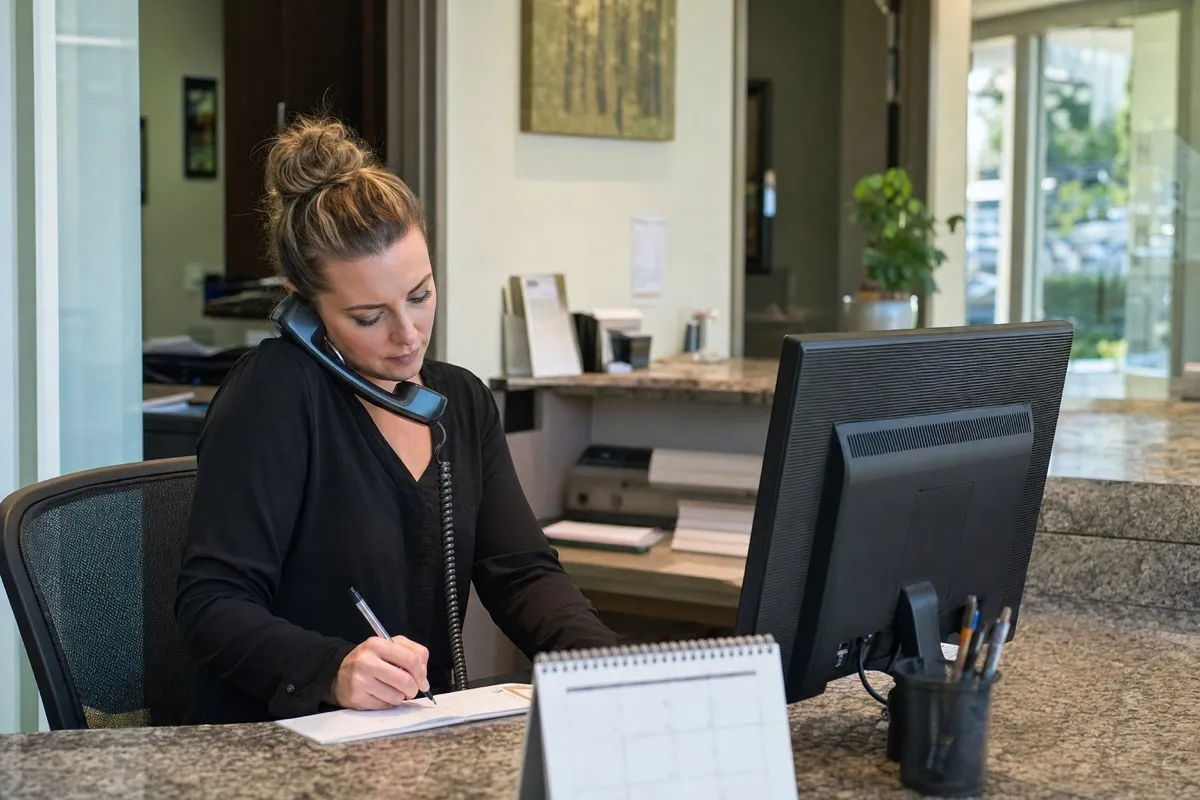
A dental answering service is anything that picks up your practice phone when the front desk cannot, so a new-patient or recall call gets handled instead of dumping to voicemail. You have four real options: voicemail (free, but it loses callers), an in-house front desk (great, but one person on one line), a live answering service (per-call or per-minute billing, no clinical context), and an AI answering service (24/7, flat fee, books straight into the schedule).
Every vendor on the first page of Google says theirs is best. None of them puts the full option set in one honest table with what each actually costs. So here is that table.
The four ways to cover your practice phone
| Voicemail | In-house front desk | Live answering service | Hey Jodie (AI) | |
|---|---|---|---|---|
| How it works | Records a message | You employ someone | Routes calls to operators | AI answers the call itself |
| Cost model | Free | Full salary plus on-costs | Per call or per minute | Flat monthly fee |
| Answers 24/7 | n/a | No | Often, at a premium | Yes |
| Books into the schedule | No | Yes | Rarely | Yes |
| Cost is predictable | Yes | Yes | No, moves with volume | Yes |
| Best for | Almost nobody | Steady daytime volume | Overflow with a budget | Most practices |
The rest of this guide walks each row honestly, because the right choice depends on how your practice actually loses calls.
Voicemail: the "free" option that loses patients
Voicemail is the default because it is already on your phone and costs nothing. That is the only good thing about it.
The people most likely to call a dentist - someone with a cracked tooth or sudden pain - are the people least likely to leave a message. They want help now, and a recording asking for their name and number is a hurdle, not help. They hang up and call the next practice.
So voicemail is not free at all. It costs you the new patients you can least afford to lose, and those are worth far more than the call. We work the full numbers in what a dental front desk really costs, but the short version is that a single new patient is worth hundreds to thousands of dollars over the time they stay with you. Voicemail trades that away for nothing.
In-house front desk: excellent, but one person on one line
A front-desk coordinator who knows your patients is genuinely the best experience a caller can get. They hold a warm conversation, handle the odd question, and make people feel looked after.
The catch is cost and coverage. A front-desk hire is a full salary plus payroll taxes, benefits, PTO, and sick coverage, which lands at a meaningfully bigger number than the headline wage. And it is still one person on one line. They cannot answer a new-patient call while checking a patient in, on lunch, out sick, or after the practice closes - and the after-hours and overflow calls are often the new-patient ones. An in-house front desk is the right call for a practice with steady daytime volume and the budget for it, but it leaves the edges uncovered.
Live answering services: watch the meter
A traditional answering service routes your overflow to a team of human operators, usually billed per call or per minute. It covers the hours your desk cannot, which is the real draw.
Two things to weigh. First, the bill is unpredictable: in a busy month, per-minute pricing climbs with your call volume, exactly when you can least predict it. Second, the operators are generalists. They are not in your schedule and they do not know your practice, so they take a message rather than book an appointment, which means your team still has to call the patient back, and the booking can still slip. It beats voicemail, but you are paying a moving fee for a message, not a booked chair.
AI answering: 24/7, flat fee, books into the schedule
An AI answering service is the newest option and it solves the specific shape of a practice's problem: new-patient and recall calls that come in while the desk is busy, at lunch, out sick, or after 5pm.
An AI receptionist answers every call instantly, day or night, holds a real conversation, captures what the caller needs, and books the appointment into the schedule - for a flat monthly fee with no per-call meter. There is no salary, no schedule to staff, and no surprise bill in a busy month. It does not replace your team's judgment or chairside care. It just makes sure no caller ever hits a dead end, which is the one thing voicemail and a nine-to-five hire both leave open.
How to choose for your practice
Here is the honest framework:
- If you genuinely never miss calls and rarely take urgent ones, voicemail is fine. Save your money.
- If you have steady daytime volume and the budget, an in-house front desk is a great hire. Just plan separately for evenings, weekends, and the calls that arrive while they are on the other line.
- If you mainly need overflow cover and do not mind a variable bill, a live answering service beats voicemail.
- If you are like most practices - losing new-patient and recall calls at lunch, after hours, and while the desk is busy - an AI answering service gives you the one thing the others cannot: every call answered and booked, at any hour, for a predictable fee.
The right answer is the one that matches how you actually lose calls. For a practice with a phone that rolls to voicemail at lunch and after 5pm, that is rarely voicemail and rarely a nine-to-five hire alone. It is something that picks up every single time. For the bigger picture, see how Hey Jodie works for dental practices, or read the marketing playbook on getting more dental patients without dropping the calls your spend brings in.
Frequently asked questions
- How much does a telephone answering service cost?
- A live answering service usually bills per call or per minute, so a typical practice pays anywhere from a few hundred dollars a month to well over a thousand in a busy month, and the bill rises with your call volume. An AI answering service charges a flat monthly fee with no per-call meter, so the cost is the same whether you take ten calls or two hundred.
- Is there a free answering service?
- Voicemail is the only genuinely free option, and it is free because it does not answer anyone. The new-patient caller who hits a recording simply dials the next practice, so voicemail does not save you money - it quietly costs you the patients your marketing already paid to reach.
- Is an answering service worth it for a dental practice?
- Yes, for most practices, because the math is lopsided. A new patient is worth hundreds or thousands of dollars over the time they stay with you, so capturing a single new-patient call that would otherwise have gone to voicemail covers a month of coverage several times over. The break-even is one patient.
- What is the 2-2-2 rule in dentistry?
- The 2-2-2 rule is a recall guideline some practices use to keep a regular cadence of checkups and hygiene visits across the year. It only works if someone answers when the patient calls to book, which is exactly the call practices lose most.
More dental offices guides
The real cost of a dental front desk (and the price of every missed call)
The receptionist wage on the job ad is the small number. Here is the loaded cost of a dental front desk - salary, payroll taxes, benefits, PTO and absence cover - weighed against the new-patient calls that roll to voicemail.
How to get more dental patients (without losing the calls)
Where new dental patients actually come from, ranked by cost and conversion, and the final step the agencies leave out: capturing the phone call your marketing already paid for.
The chiropractic front desk playbook: calls, scripts, and no-shows
The operator playbook no answering-service vendor hands you: a new-patient intake script, an after-hours and overflow protocol, the no-show tactics that actually move the rate, and the three numbers to track so no booking slips away.